Widest gap
Media & Entertainment
67
Media & Entertainment has the widest Change-Response Gap on the Index this month.
Measures the Change-Response Gap: how fast industries are changing versus how fast companies are responding. 50 means they are even. Higher means the gap is wider.
Industries are changing 1.5x faster than companies are responding.
Companies are keeping up with about 70% of the change around them.
The Hyder Index measures the Change-Response Gap: how fast industries are changing versus how fast companies are responding. 50 means they are even. Higher means the gap is wider. How we measure it →
Data window: May 1-31, 2026. Published July 7, 2026.
Updated the first Tuesday of every month. Next edition: November 3.
Media & Entertainment has the widest Change-Response Gap on the Index this month.
Each moved 1 points.
Financial Services & FinTech, Hospitality & Travel
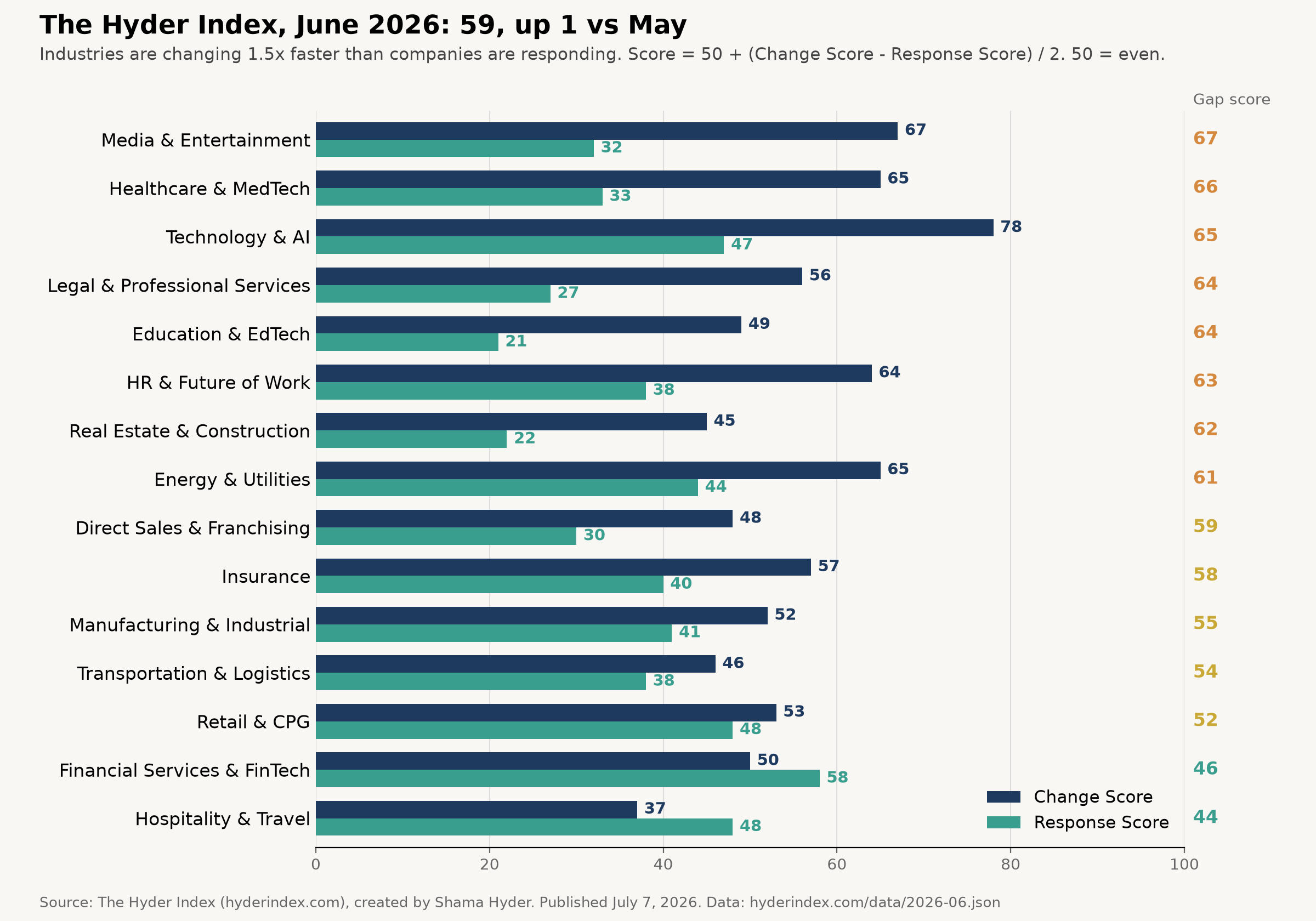
This edition was published together with July's on July 7, and its scores are based on May signal data. The Hyder Index rose to 59. Five industries each widened by 1 point, the other ten held, and no industry changed zones. Most of the pressure came from the physical economy.
A fuel shock hit Transportation & Logistics and Hospitality & Travel. Data center power demand pushed Energy & Utilities. Heavy May tech layoffs pushed HR & Future of Work. Retail & CPG moved as shoppers turned to AI for product advice. Hospitality was the only industry where response rose, and it still keeps pace with change.
Each industry gets a score from 0 to 100. 50 means companies are keeping pace with the change around them. Higher means change is winning.
Hospitality & Travel rose 1 point to 44 and stayed in the Keeping Pace zone. It still has the narrowest gap on the Index. Three forces pushed its change side up in May. Jet fuel prices spiked after the Iran conflict. Consumer spending split further, with some travelers cutting back and others spending more. The World Cup, then weeks away, began to shift where travel demand would land.
Companies in the industry responded, and the response score rose 2 points. Change rose faster, by 4 points, so the gap widened slightly. Hospitality's response did not fall. The world around it just sped up. It and Financial Services & FinTech are the only industries still keeping pace with change.
HR & Future of Work rose 1 point to 63, in the Significant Gap zone. Employers announced 38,242 tech job cuts in May, the heaviest month of the year so far. Meta, the Facebook parent, laid off 8,000 people on May 20. It also reassigned 7,000 employees to AI work. Cisco, the networking company, cut 4,000 jobs and cited AI. Intuit, the TurboTax maker, cut roughly 3,000.
Companies are cutting jobs and moving people toward AI at the same time. HR's response score did not move, so the change side alone widened the gap. HR & Future of Work now has the sixth-widest gap on the Index.
Six observable signals of change from the May data window, one per signal, across the economy.
58% of consumers have replaced traditional search with generative AI for product recommendations, according to reports in May. Amazon, the online retailer, folded its Rufus shopping assistant into Alexa for Shopping in May.
Employers announced 38,242 tech job cuts in May, the heaviest month of the year so far. Meta, the Facebook parent, laid off 8,000 people on May 20. It also reassigned 7,000 employees to AI work. Cisco, the networking company, cut 4,000 jobs and cited AI. Intuit, the TurboTax maker, cut roughly 3,000.
Cerebras, the AI chipmaker, went public on May 14 at $185 a share. The stock opened at $350. It closed its first day up 68%, for a $95B market value. The debut opened a run of large AI stock listings. It followed a first quarter in which global venture funding reached $330.9B. AI drew more than 80% of that money.
Colorado replaced its original AI law before its provisions took effect, and the revised law takes effect at the start of 2027.
The K-shaped consumer hardened, with spending splitting between people cutting back and people spending more. Only 45% of US travelers planned a paid-lodging vacation, a six-year low, according to survey data. Travelers who are still going raised their budgets 17%. Their average budget for their longest trip reached $4,069.
Goldman Sachs, the investment bank, projected on May 20 that US data center power demand will more than double by 2027. It put demand at 31 GW in 2025. It projects 66 GW in 2027. The bank flagged grid reliability risks in the Mid-Atlantic, Mid-Continent, and Northwest. The limit on AI is shifting from chips to electricity.
The number that matters this month is small. Only two industries still keep pace with change.
Hospitality & Travel has been the Index's proof that an industry can respond as fast as its world changes. That proof held in June, but it got harder. A fuel shock, a split consumer, and a World Cup on the doorstep pushed its change score up. Hospitality's response did not fall. It rose, and the world still sped up faster.
That is the pattern under the Index's small rise. The Change-Response Gap is moving toward industries that touch the physical world. Technology & AI held at 65. Energy ticked up because the grid math got worse. Transportation ticked up because fuel repriced fast. HR & Future of Work rose because May was the heaviest layoff month of the year so far.
The misread is the small move. A 1-point rise can look like calm. The average blends a technology industry that held steady with a physical economy that is just starting to feel the pressure. Under the calm surface, five industries moved, and every one of them widened.
The window is still open. No industry is in the Critical Gap zone. Hospitality shows how an industry stays ahead, because seasons and competition force it to adapt fast. But its margin is shrinking. This month, its change rose twice as fast as its response.
Run the Hospitality test on your own company. Ask whether your response would be enough at the current pace of change, even if it were the best in your industry. For most industries, the answer is already no. Thirteen of fifteen industries have a gap wider than even.
Keeping pace is still possible. It takes a response that rises as fast as change does.
Per the Hyder Index, the June 2026 reading is 59, and industries are changing 1.5x faster than companies are responding.
The two independent reviewers' ratings differed by 0.15 points on average on the 0 to 5 scale.
One email a month. The Hyder Index, the movers, and what to do about it.
Get the edition 24 hours early, with citation language and data links ready to use.