Widest gap
Media & Entertainment
68
Media & Entertainment has the widest Change-Response Gap on the Index this month.
Measures the Change-Response Gap: how fast industries are changing versus how fast companies are responding. 50 means they are even. Higher means the gap is wider.
Industries are changing 1.5x faster than companies are responding.
Companies are keeping up with about 70% of the change around them.
The Hyder Index measures the Change-Response Gap: how fast industries are changing versus how fast companies are responding. 50 means they are even. Higher means the gap is wider. How we measure it →
Data window: June 1-30, 2026. Published July 7, 2026.
Updated the first Tuesday of every month. Next edition: November 3.
Media & Entertainment has the widest Change-Response Gap on the Index this month.
Healthcare & MedTech fell 2 points to 64.
Financial Services & FinTech, Hospitality & Travel
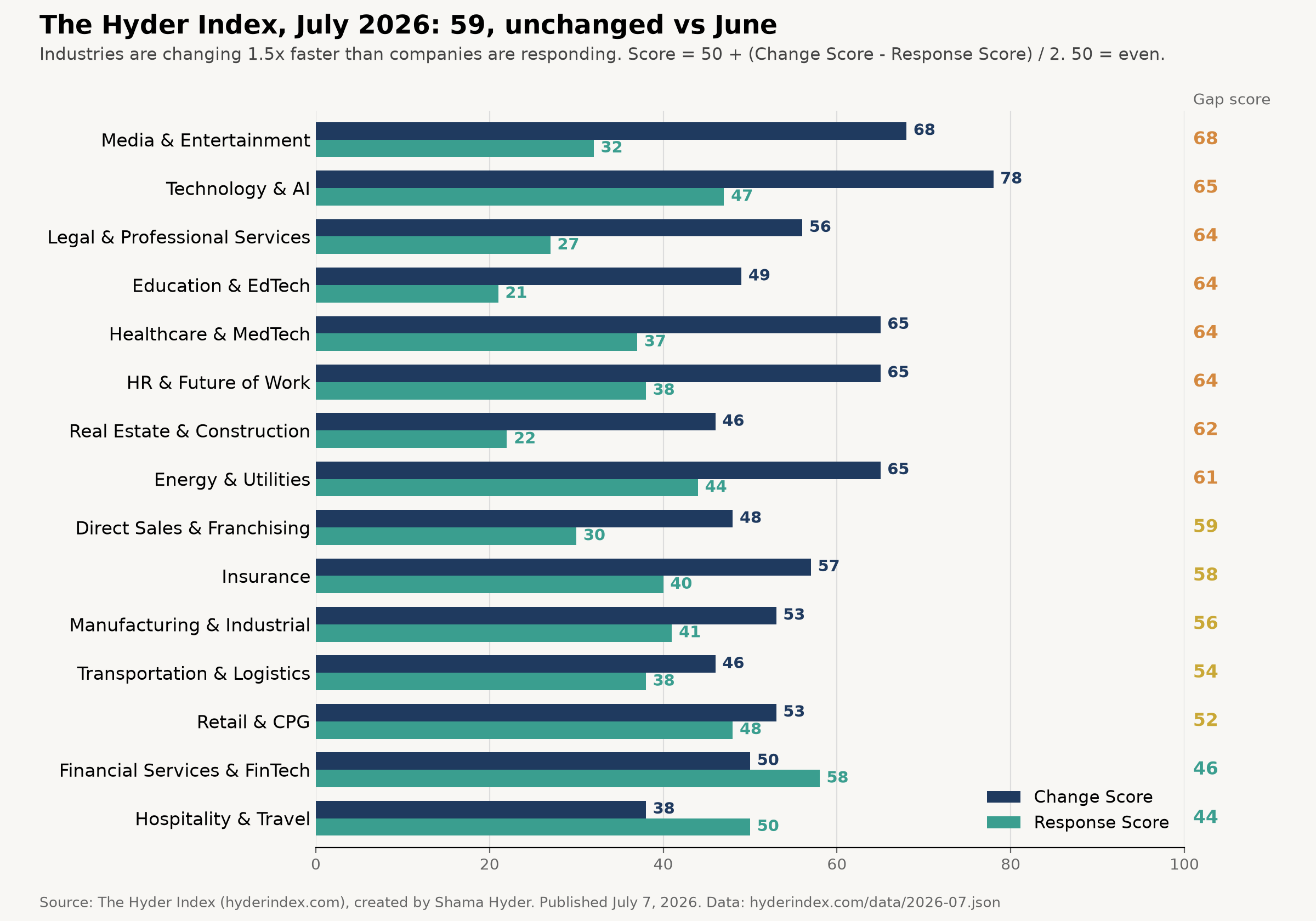
The Hyder Index held at 59 in July. Industries are changing 1.5x faster than companies are responding. Under that steady reading, two industries moved in opposite directions on the Change-Response Gap.
Healthcare & MedTech narrowed its gap by 2 points, the largest move of the month. It is the first time any industry's gap has narrowed on the Index. The reason was response, as NHS England committed AI tools to all of its staff. Media & Entertainment went the other way. At 68, it now has the widest gap the Index has recorded. No industry changed zones this month.
Each industry gets a score from 0 to 100. 50 means companies are keeping pace with the change around them. Higher means change is winning.
Healthcare & MedTech made the biggest move in July. Its score fell by 2 points. That is the first time any industry's gap has narrowed on the Index. NHS England, the public health service for England, committed AI tools to all 505,000 of its staff. The decision followed a trial with 30,000 staff. NHS England said the trial saved each person 43 minutes per day.
The pressure on the industry did not ease. Its Change Score held at 65. The gap narrowed because response rose, with the Response Score up 4 points. That was the largest response gain on the Index this month. At 64, Healthcare still sits in the Significant Gap zone, tied for third widest.
Media & Entertainment's gap widened by 1 point in July. At 68, it is the widest gap the Index has recorded. Cannes, the advertising industry's yearly festival, showed why. The industry held its biggest celebration of AI creative tools one year after stripping awards from campaigns that used AI to fake results. Entries fell 25%.
Marketers are using AI but have not changed how they work. Sixty percent of marketers say they use AI weekly. Only 10% say they have redesigned how the work gets done. The rise came from the change side, and the Response Score held at 32. Money also kept moving. Suno, an AI music company, raised $400 million while record labels were suing it.
Six observable signals of change from the June data window, one per signal, across the economy.
A third of consumers say they expect AI to handle part of their purchases within a year. Today, agents touch about 3% of transactions. In addition, 57% of consumers say they would let an agent switch brands for better value.
AI was the top stated reason for US job cuts for the fourth month in a row. Challenger, Gray & Christmas, a firm that tracks layoffs, counted 101,743 AI-cited cuts in the first half of the year. Oracle, the software company, disclosed 21,000 cuts as ongoing policy.
Capital kept moving into AI-native markets even where the legal and operating risks are unresolved. Suno, an AI music company, raised $400 million while record labels were suing it. Steno, a legal AI company, raised $49 million for tools aimed at billable work.
The incentive shifted from watching AI regulation to proving governance before anyone asks. Formal state deadlines are further off than they first looked. Colorado replaced its original AI law in May 2026, and its new law takes effect January 1, 2027.
The World Cup is already shifting demand across 16 host cities. Cannes, the advertising industry's yearly festival, pointed to the same pressure from another angle. Live, emotionally engaged attention is getting more valuable as AI floods everything else.
Gartner, a research firm, projects data center power demand will rise 27% in 2026, faster than the grid can easily absorb. In the same window, NHS England, the public health service for England, moved from a trial to national AI deployment. That shows disruption widens the gap only when response stays stuck.
July did two things the Index had not seen before. It recorded its widest gap yet. It also recorded the first time an industry's gap narrowed. The forces were similar, but the outcomes were opposite, so the forces alone did not decide them.
Start with the narrowing, because it is rarer. Healthcare & MedTech improved while the pressure on it held steady. What changed was response. NHS England, the public health service for England and one of the largest employers on earth, ran an AI trial with 30,000 staff. NHS England said the trial saved each person 43 minutes per day. Then it did what most health systems have spent two years not doing. It deployed AI tools to all of its staff at national scale. One decision moved an entire industry's score.
Now the widening. Media & Entertainment reached 68, the widest gap the Index has recorded. Cannes, the advertising industry's yearly festival, explained it in one contradiction. The industry held its biggest celebration of AI creative tools one year after stripping awards from campaigns that used AI to fake results. Entries fell 25%. Sixty percent of marketers say they use AI every week. Only 10% say they have redesigned how the work gets done. The people are fluent, and the institutions are behind. Capital is not waiting for them to catch up. Suno, an AI music company, raised $400 million while record labels were suing it.
The misread is June's layoff slowdown. Announced tech job cuts fell to 15,503 in June. In May, they had been 38,242. The tempting read is that the storm passed. Oracle's filing points the other way. The software company disclosed 21,000 job cuts spread over a year as ongoing policy. When companies stop announcing layoffs and start budgeting them, the pressure has become permanent.
The window is agentic commerce, where AI agents make purchases on a consumer's behalf. A third of consumers say they expect AI to handle part of their purchases within a year. Today, agents touch about 3% of transactions. That leaves a wide adoption gap on roughly a one-year clock. In addition, 57% of consumers say they would let an agent switch brands for better value. Consumer companies have about two quarters to become the answer an agent selects, instead of the brand a person remembers.
Copy healthcare's move. Somewhere in your organization is a pilot that already proved itself and never got a deployment decision. The data exists, and the signal is verified. The only missing input is someone deciding. This month, one industry showed what that decision is worth. It produced the first narrowing of an industry gap the Index has recorded.
Per the Hyder Index, the July 2026 reading is 59, and industries are changing 1.5x faster than companies are responding.
The two independent reviewers' ratings differed by 0.15 points on average on the 0 to 5 scale.
One email a month. The Hyder Index, the movers, and what to do about it.
Get the edition 24 hours early, with citation language and data links ready to use.