Widest gap
Media & Entertainment
67
Media & Entertainment has the widest Change-Response Gap on the Index this month.
Measures the Change-Response Gap: how fast industries are changing versus how fast companies are responding. 50 means they are even. Higher means the gap is wider.
Industries are changing 1.4x faster than companies are responding.
Companies are keeping up with about 70% of the change around them.
The Hyder Index measures the Change-Response Gap: how fast industries are changing versus how fast companies are responding. 50 means they are even. Higher means the gap is wider. How we measure it →
Baseline edition. Published May 6, 2026.
Updated the first Tuesday of every month. Next edition: November 3.
Media & Entertainment has the widest Change-Response Gap on the Index this month.
Hospitality & Travel is closest to keeping pace with change.
Financial Services & FinTech, Hospitality & Travel
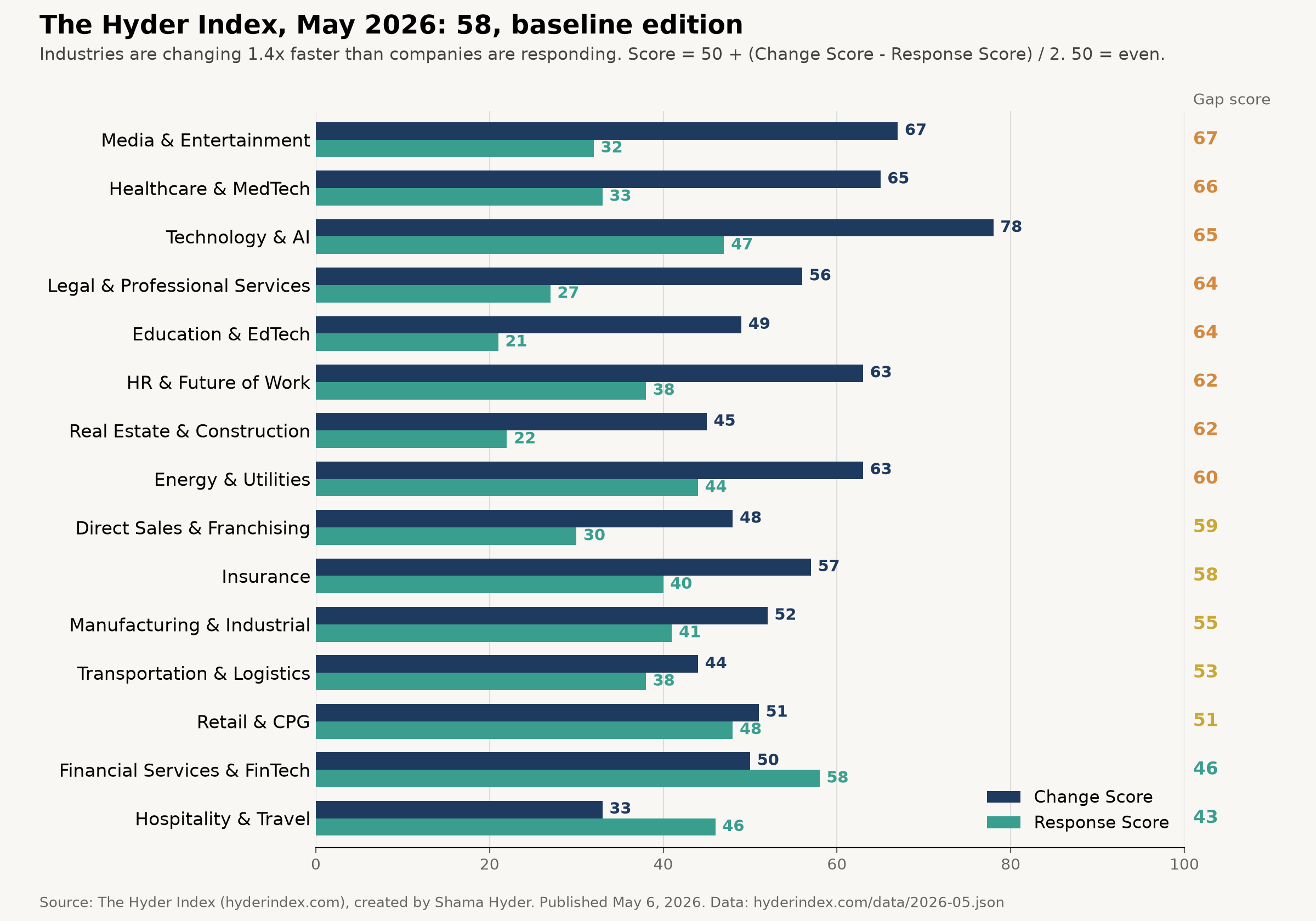
May is the baseline edition of the Hyder Index, so there are no monthly moves yet. The Index opens at 58, in the Narrow Gap zone. Eight industries sit in the Significant Gap zone. Five are in the Narrow Gap zone. Two are keeping pace, and none is in the Critical Gap zone.
Media & Entertainment has the widest Change-Response Gap, at 67, as AI search summaries pull readers away from publishers. Technology & AI has the fastest change of any industry, with a Change score of 78. Its companies are also responding faster than most, so it ranks third, at 65. Hospitality & Travel and Financial Services & FinTech are keeping pace.
Each industry gets a score from 0 to 100. 50 means companies are keeping pace with the change around them. Higher means change is winning.
Media & Entertainment starts the Hyder Index with the widest Change-Response Gap, at 67. Its Change score is 67. Its Response score is 32, one of the five lowest in the Index. The main force is search. Google, the largest search engine, now puts AI summaries at the top of its results. Studies by Pew Research, a nonpartisan research group, and Seer Interactive, a search marketing firm, found those summaries cut clicks to publishers by 46% to 61%.
Few publishers have responded at the same speed. The New York Times, a national newspaper, and Axios, a news site, are the clear exceptions, with AI tools and video projects. Axios says it has expanded its local news service to 41 cities. Elsewhere, only 44% of publishers told the Reuters Institute, a journalism research center, that their AI efforts looked promising. Many are still reacting to traffic losses months after those losses became measurable.
Two of the 15 industries start in the Keeping Pace zone, where response matches or beats change. Hospitality & Travel has the lowest score in the Index, at 43. Its Change score is 33, the lowest of any industry. Its Response score is 46. Hotels and airlines already use AI for pricing and revenue management. The pandemic forced the industry to rebuild how it operates, and that habit of quick change has lasted.
Financial Services & FinTech is the other industry keeping pace, at 46. Its Response score of 58 is the highest of any industry. JPMorgan Chase and Goldman Sachs, two of the largest US banks, give specific AI deployment figures on their earnings calls. Smaller banks trail. Regional and community banks put under 5% of their tech budgets into AI, according to McKinsey, a consulting firm.
Six observable signals of change from the Baseline data window, one per signal, across the economy.
Customers vote before they speak. Shifts in behavior, loyalty, and wallet share show up in the data long before they show up in feedback.
Where skilled people flow, and where they flee, predicts where value is moving next.
Follow the capital. Investment, funding, and spending patterns reveal where smart money believes the future is.
Regulation, pricing, and policy quietly re-weight what gets rewarded. When the incentives move, behavior follows.
Slow-moving shifts in values and expectations suddenly release. What society tolerates, celebrates, and demands is a leading indicator.
New technology and new entrants rewire how an industry connects. One switch flips and every downstream assumption changes.
Per the Hyder Index, the May 2026 reading is 58, and industries are changing 1.4x faster than companies are responding.
The two independent reviewers' ratings differed by 0.15 points on average on the 0 to 5 scale.
One email a month. The Hyder Index, the movers, and what to do about it.
Get the edition 24 hours early, with citation language and data links ready to use.