Widest gap
Media & Entertainment and Real Estate & Construction
66
Media & Entertainment and Real Estate & Construction have the widest Change-Response Gap on the Index this month.
Measures the Change-Response Gap: how fast industries are changing versus how fast companies are responding. 50 means they are even. Higher means the gap is wider.
Industries are changing 1.3x faster than companies are responding.
Companies are keeping up with about 75% of the change around them.
The Hyder Index measures the Change-Response Gap: how fast industries are changing versus how fast companies are responding. 50 means they are even. Higher means the gap is wider. How we measure it →
Data window: September 1-30, 2026. Published October 6, 2026.
Updated the first Tuesday of every month. Next edition: November 3.
Media & Entertainment and Real Estate & Construction have the widest Change-Response Gap on the Index this month.
Legal & Professional Services fell 2 points to 65.
Financial Services & FinTech, Hospitality & Travel
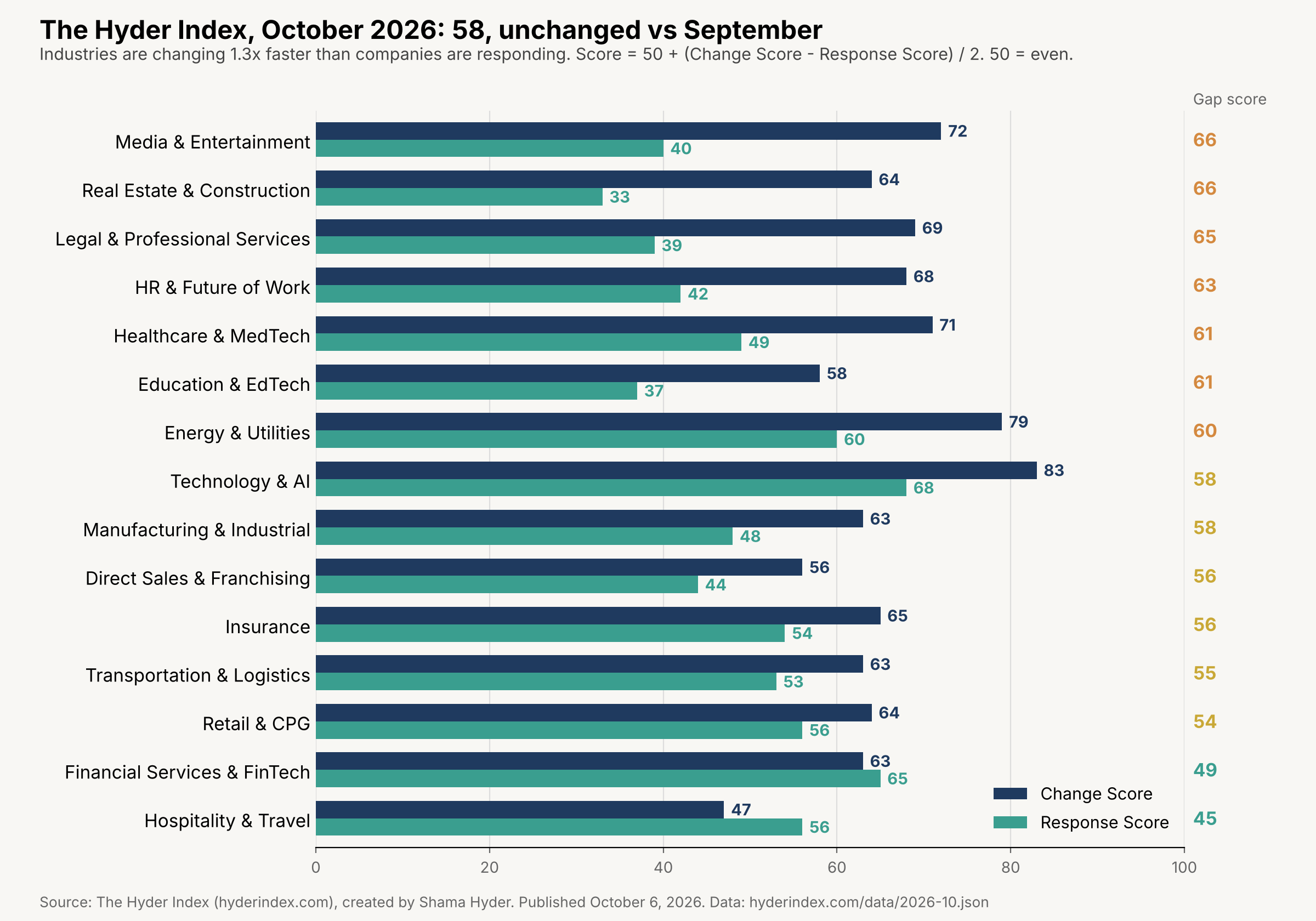
Legal & Professional Services fell two points to 65, and its response is the reason. Its Response Score rose five points, from 34 to 39, the largest response gain of the 15 industries. Morgan & Morgan, a large plaintiffs' firm, committed at least $1 billion to AI over the next decade. At least 16 top firms are advertising AI roles. Latham & Watkins, Ropes & Gray, Cooley and Sullivan & Cromwell started building on OpenAI's new legal model. Legal is no longer the widest gap. Only 29% of law firms have changed how they price AI work, so the response is still early.
Each industry gets a score from 0 to 100. 50 means companies are keeping pace with the change around them. Higher means change is winning.
Legal & Professional Services fell two points to 65 in October, and it is no longer the widest gap on the Hyder Index. Its Response Score rose five points, from 34 to 39, the largest response gain of the 15 industries. Its Change Score rose one point to 69.
Big firms started to spend. Morgan & Morgan committed at least $1 billion to AI and legal technology over the next decade. Its internal platform, MX2, has nearly 5,000 monthly active users. Latham & Watkins, Ropes & Gray, Cooley and Sullivan & Cromwell became early adopters of Astra for Law, the legal model OpenAI launched on September 18.
Most of this is still announcements. Job postings are not hires, and only 29% of law firms have changed how they price AI work, per BigHand, a legal software company. A public database kept by researcher Damien Charlotin counted 2,046 court cases worldwide involving AI-fabricated citations or content by September 21. The vendors and the courts are moving fast, and the firms are catching up.
Transportation & Logistics rose one point to 55. Its Change Score rose four points to 63, up from 59 in September, the largest change gain on the Index. Its Response Score rose one point to 53.
Demand showed up first. The Cass Freight Index shipments component rose 2.1% from a year earlier in August. It was the first annual gain since January 2023, and Cass described it as the end of a 42-month freight downturn.
Costs followed. Diesel hit a record $6.529 a gallon for the week of September 21, up from $5.967 on September 7. At least 16 trucking, delivery and transportation companies entered bankruptcy court between late August and September 21. Carriers raised fuel surcharges as high as 45% within weeks. Freight demand is recovering into a cost squeeze, and the response so far is about pricing, not AI.
Six observable signals of change from the September data window, one per signal, across the economy.
Shoppers kept spending while their mood fell. The Census Bureau said August retail sales were $773.9 billion, up 1.2% from July. That is 6.0% above a year earlier. Then the Conference Board, the business research group, said its consumer confidence index fell 6.7 points to 81.9 in September, the lowest since 2014. Forecasters had expected 89.2. People are buying today and worrying about tomorrow. Freight is showing the same turn. The Cass Freight Index shipments component rose 2.1% from a year earlier in August, the first annual gain since January 2023.
Sources: U.S. Census Bureau, September 16, 2026; CNBC, September 29, 2026; Cass Information Systems, September 8, 2026
Job cuts jumped in August. Challenger, Gray & Christmas, the outplacement firm, counted 52,881 announced US cuts, up 58% from July. Technology cuts reached 155,126 through August, up 52% from a year earlier. September opened the same way. Uber said it will cut 3,300 jobs, about 10% of its workforce, and Oracle has cut about 21,000 roles this year. Trucking felt it too. Truck transportation employment fell to 1.47 million in August, about 118,000 below the October 2022 peak. Layoff totals like these count announcements, so they run ahead of actual departures.
Sources: Challenger, Gray & Christmas, September 3, 2026; CNBC, September 2, 2026; Business Standard, September 11, 2026; Yahoo Finance (FreightWaves), September 22, 2026
Money got more expensive, and AI money kept coming anyway. The Federal Reserve raised its rate 25 basis points to a range of 3.75% to 4% on September 16, its first increase since 2023. The 30-year mortgage rate averaged 7.03% by September 24. Twelve days later, on September 28, Instinct, an AI agent startup, raised $1 billion at a $10 billion valuation. JPMorgan chief executive Jamie Dimon said hyperscaler AI spending could reach $1 trillion next year, up from about $700 billion this year. The Fed meets again October 27 and 28.
Sources: CNBC, September 16, 2026; TechCrunch, September 28, 2026; GuruFocus, September 22, 2026
New rules arrived with start dates far out. Commerce Secretary Howard Lutnick said on September 2 that the administration is weighing new chip tariffs, with exemptions for companies that build chips in the US. The House passed the Ratepayer Protection Act on September 16, which asks states to consider making data centers pay the full cost of grid upgrades. It still needs a Senate vote. California's governor signed seven data center bills on September 21. The laws take effect January 1, 2027, and regulators must set new data center power tariffs by 2028. He also signed Adam's Law on September 10, which requires risk assessments before new AI chatbots launch. Its requirements start July 1, 2027.
Sources: Bloomberg, September 2, 2026; The Daily Caller, September 16, 2026; California Governor's Office, September 21, 2026; California Governor's Office, September 10, 2026
Worry about AI is now a majority view in more than one poll. Pew Research Center reported on September 17 that 71% of US adults say AI will lead to fewer jobs over two decades. That is up from 64% in 2024. A CNN poll a week later found 75% of US adults express fear and concern about AI, with broad bipartisan support for more government regulation. An Ipsos poll released September 16 found 69% are concerned about data center construction, with water use (50%) and energy supply strain (41%) as the top worries. The worry now extends from jobs to water and power.
Sources: Pew Research Center, September 17, 2026; CNN, September 24, 2026; Ipsos, September 16, 2026
The tools got stronger in the same month the spending forecasts got bigger. OpenAI's GPT-6 Astra scored 100% on ExploitBench, a cyber test, versus 78.5% for its prior model, and crossed the company's Critical cyber threshold. On September 18, OpenAI launched Astra for Law, with a search index of more than 230 million case law, statute and regulatory sources. Anthropic's annualized revenue is on track to top $100 billion this year, per a New York Times report. That is up from a $65 billion run rate at the end of July. PwC projected annual data center spending near $800 billion in 2026.
Sources: CNBC, September 3, 2026; Global Legal Post, September 18, 2026; Bloomberg, September 18, 2026; PwC, September 2, 2026
The Hyder Index held at 58 in October, unchanged from September. The average Change Score is 65.6 and the average Response Score is 49.6, so industries are still changing 1.3 times faster than companies respond. That ratio was also 1.3 in August and September.
Evidence was thin for several industries this month, so many scores held at September's level. Two industries are in Keeping Pace, and none is in the Critical Gap zone. The clearest moves came in Legal and Transportation, where the evidence was strongest.
Legal's score fell two points, so it can look like the industry caught up. The response did rise five points, but read what is inside it. A billion-dollar pledge over ten years is a plan. Job postings are not hires. Early adopters are four firms.
The number to watch is pricing. Only 29% of law firms have changed how they price AI work, per BigHand, a legal software company. BigHand also found that 49% of firms report rising client demand for alternative fee arrangements. Clients are asking, and most bills have not changed.
Third-quarter earnings season starts in mid-October, and it is where companies put numbers behind their AI plans. FactSet found that 67% of S&P 500 companies mentioned AI on their second-quarter calls. Kroger's call transcript included no AI figures.
The Federal Reserve meets October 27 and 28, after its first rate increase since 2023. Money is more expensive, yet KPMG found planned AI investment averaging $210 million per organization, up from $186 million in the first quarter. The companies that name a number now will be easy to compare with the ones that stay quiet.
Pick one workflow where your clients or customers already feel the change. Set a date and a number for it, and say both out loud to your team and to your customers. If you sell by the hour or by the seat, look at your pricing first, because that is where the gap shows up in the bill. Then put the result on your next earnings call, board update or client letter.
Per the Hyder Index, the October 2026 reading is 58, and industries are changing 1.3x faster than companies are responding.
One email a month. The Hyder Index, the movers, and what to do about it.
Get the edition 24 hours early, with citation language and data links ready to use.