Widest gap
Real Estate & Construction
65
Real Estate & Construction has the widest Change-Response Gap on the Index this month.
Measures the Change-Response Gap: how fast industries are changing versus how fast companies are responding. 50 means they are even. Higher means the gap is wider.
Industries are changing 1.3x faster than companies are responding.
Companies are keeping up with about 75% of the change around them.
The Hyder Index measures the Change-Response Gap: how fast industries are changing versus how fast companies are responding. 50 means they are even. Higher means the gap is wider. How we measure it →
Data window: July 1-31, 2026. Published August 4, 2026.
Updated the first Tuesday of every month. Next edition: November 3.
Real Estate & Construction has the widest Change-Response Gap on the Index this month.
Each moved 6 points.
Financial Services & FinTech, Hospitality & Travel
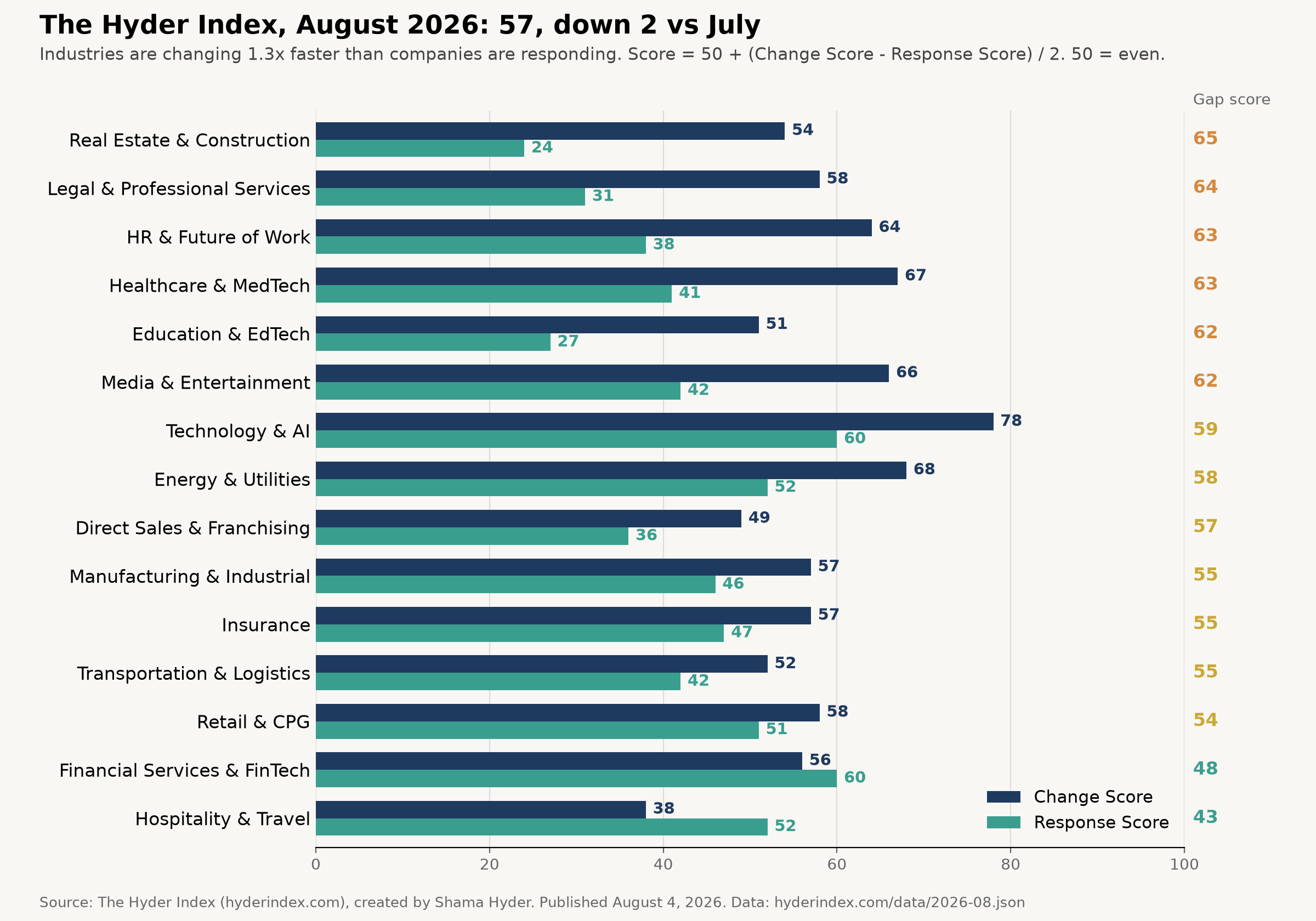
The Hyder Index fell for the first time, from 59 to 57. Change did not slow down. Companies sped up. Response Scores rose in 14 of 15 industries. Netflix, the streaming service, said it used AI in about 300 titles. State Farm, the insurer, made daily AI use part of its agent contracts. Taco Bell, the fast-food chain, said its AI took orders at nearly 900 drive-thrus. The biggest US banks started building a shared digital-dollar system. One catch remains. Companies bought AI faster than they trained their people to use it.
Each industry gets a score from 0 to 100. 50 means companies are keeping pace with the change around them. Higher means change is winning.
Technology & AI fell 6 points to 59 this month. That moved it out of the Significant Gap and into the Narrow Gap. Its Change Score held at 78, so the pressure did not ease. Its Response Score rose from 47 to 60, the biggest response gain on the Index.
Earnings calls in late July put numbers behind the talk. Microsoft, the software and cloud company, said its Azure cloud business grew 43%. Azure also passed $100 billion a year in sales, Microsoft said. Amazon, the online retailer and cloud provider, said its AWS cloud unit grew 37%. The four biggest tech companies plan to spend about $600 billion this year on AI data centers and chips. Four major AI models launched in July. Apple, the iPhone maker, moved its new Siri to Google's Gemini model instead of waiting on its own. Investors are now grading AI spending against AI results.
Real Estate & Construction rose 3 points to 65. That is now the widest gap on the Index, and the first time this industry has held the top spot. Its Change Score jumped from 46 to 54. Its Response Score rose only from 22 to 24.
AI is now driving the construction market itself. Data center construction starts reached $81.5 billion in the first half of 2026. That is already more than all of 2025. Construction robotics companies raised over $100 million in July. Home builders answered a slow market with discounts. PulteGroup, a large home builder, reported orders up 6% on heavy discounts and incentives. Its earnings call did not mention AI. NVR, another large builder, cut prices about 5% to grow orders. The pressure on this industry is coming from outside, and most of the response is still price cuts.
Six observable signals of change from the July data window, one per signal, across the economy.
AI shopping went mainstream this summer. In a CI&T survey, 74% of consumers said they have used an AI agent while shopping. In the same survey, 55% said AI makes them shop more. During Prime Day, shoppers who arrived at retail sites from AI tools bought at a 40% higher rate than everyone else, according to Adobe, the software company. A year ago, those shoppers bought at a 23% lower rate. AI went from a place people browse to a place people decide.
Job cut announcements slowed, with June cuts down 53% from May. The bigger number came from a bank. JPMorgan CEO Jamie Dimon said AI has already reduced staff by 30 to 40% in some of the bank's units. AI was the top stated reason for US job cuts for the fifth month in a row. US employers announced 33,429 job cuts in July, according to Challenger, Gray & Christmas, the outplacement firm. AI was cited in 10,970 of them. That brings AI-cited cuts to 112,713 so far this year. The cuts are moving out of press releases and into everyday budgets.
The four biggest tech companies said they will spend roughly $600 billion this year on AI data centers and chips. This time, the market graded them differently. Microsoft and Amazon, the two largest cloud sellers among them, rose 8 to 9% because their AI is producing revenue. Meta, the Facebook owner, fell about 10%. Alphabet, Google's parent company, spent more cash than it took in for the first time since its 2004 IPO. Investors stopped rewarding big plans. They now pay for results.
Europe's AI rules took effect on August 2. Companies can now be fined up to 15 million euros, or 3% of worldwide revenue, for breaking them. Chatbots must say they are AI, and AI-made content must be labeled. At the same time, Europe delayed its harder rules on AI in hiring and lending until December 2027. The rules covering AI that customers can see arrived first.
High school students from all 50 states met in Boston and passed their own model AI law, the Students First Act. The vote was 82 to 16. Their rules: teach AI skills from the first school device, no AI on graded tests, and no AI-written assignments. One student said, 'We missed the mark with social media and phones.' The school superintendents' association is sending the plan to 10,000 school leaders. The generation using AI the most is the one asking for rules.
The power grid sent the AI boom its first big bill. PJM, the largest US grid operator, hit the price ceiling in its yearly power auction for the third time in a row. The auction cost $16.4 billion. Data centers caused $6.3 billion of that cost. The auction also came up 6,831 megawatts short of its reliability target. Last month, rising power demand was a forecast. This month it was an invoice.
The Hyder Index fell for the first time, from 59 to 57. Change did not slow down. The average Change Score rose from 55.7 to 58.2. What moved was the response. Response Scores rose in 14 of 15 industries. The average Response Score climbed from 38.2 to 43.3. The Gap Ratio tightened from 1.5x to 1.3x.
And this was real deployment. England's National Health Service turned one decision into a £10 billion AI program. Netflix, the streaming service, said it used AI in about 300 titles. State Farm, the insurer, put daily AI use into its agent contracts. Taco Bell, the fast-food chain, said its AI now takes orders at nearly 900 drive-thrus. Marriott and IHG, two large hotel companies, launched AI booking tools in the same week. In July, one decision in England's health system moved one industry. This month, moves like that showed up across the board.
The stock market noticed too. In one week of earnings reports, Microsoft and Amazon, the two cloud giants, rose 8 to 9%. Their AI spending is producing revenue. Meta, the Facebook owner, fell about 10%. Alphabet, Google's parent company, spent more cash than it took in for the first time since its 2004 IPO. Investors are now paying for results. Response is something the market prices.
The easy read is that the gap is closing because companies bought AI. Most of the new response was money and tools. Training lagged behind. The Conference Board, a business research group, found that 55% of workers use AI every day or every week. Only a third have had any employer AI training in the past six months. In schools, 92% of students have used AI, according to a Microsoft report. Yet 77% have never been taught how. HR was the one industry whose Response Score did not move. The tools are in. The training is not.
A two-point drop is small, and September will show whether this was a turn or a pause. The training gap is still wide open. Most of the training workers did get covered only basic prompting, the Conference Board found. That part of the response has barely started, so there is still room to lead.
If your company shipped AI tools this summer, many others did too. The next advantage goes to the companies that teach their people to use what they just bought. Start with the workers already using AI on their own, and train them past the basics.
Per the Hyder Index, the August 2026 reading is 57, and industries are changing 1.3x faster than companies are responding.
The two independent reviewers' ratings differed by 0.15 points on average on the 0 to 5 scale.
One email a month. The Hyder Index, the movers, and what to do about it.
Get the edition 24 hours early, with citation language and data links ready to use.