Widest gap
Legal & Professional Services
67
Legal & Professional Services has the widest Change-Response Gap on the Index this month.
Measures the Change-Response Gap: how fast industries are changing versus how fast companies are responding. 50 means they are even. Higher means the gap is wider.
Industries are changing 1.3x faster than companies are responding.
Companies are keeping up with about 75% of the change around them.
The Hyder Index measures the Change-Response Gap: how fast industries are changing versus how fast companies are responding. 50 means they are even. Higher means the gap is wider. How we measure it →
Data window: August 1-31, 2026. Published September 1, 2026.
Updated the first Tuesday of every month. Next edition: November 3.
Legal & Professional Services has the widest Change-Response Gap on the Index this month.
Media & Entertainment rose 4 points to 66.
Financial Services & FinTech, Hospitality & Travel
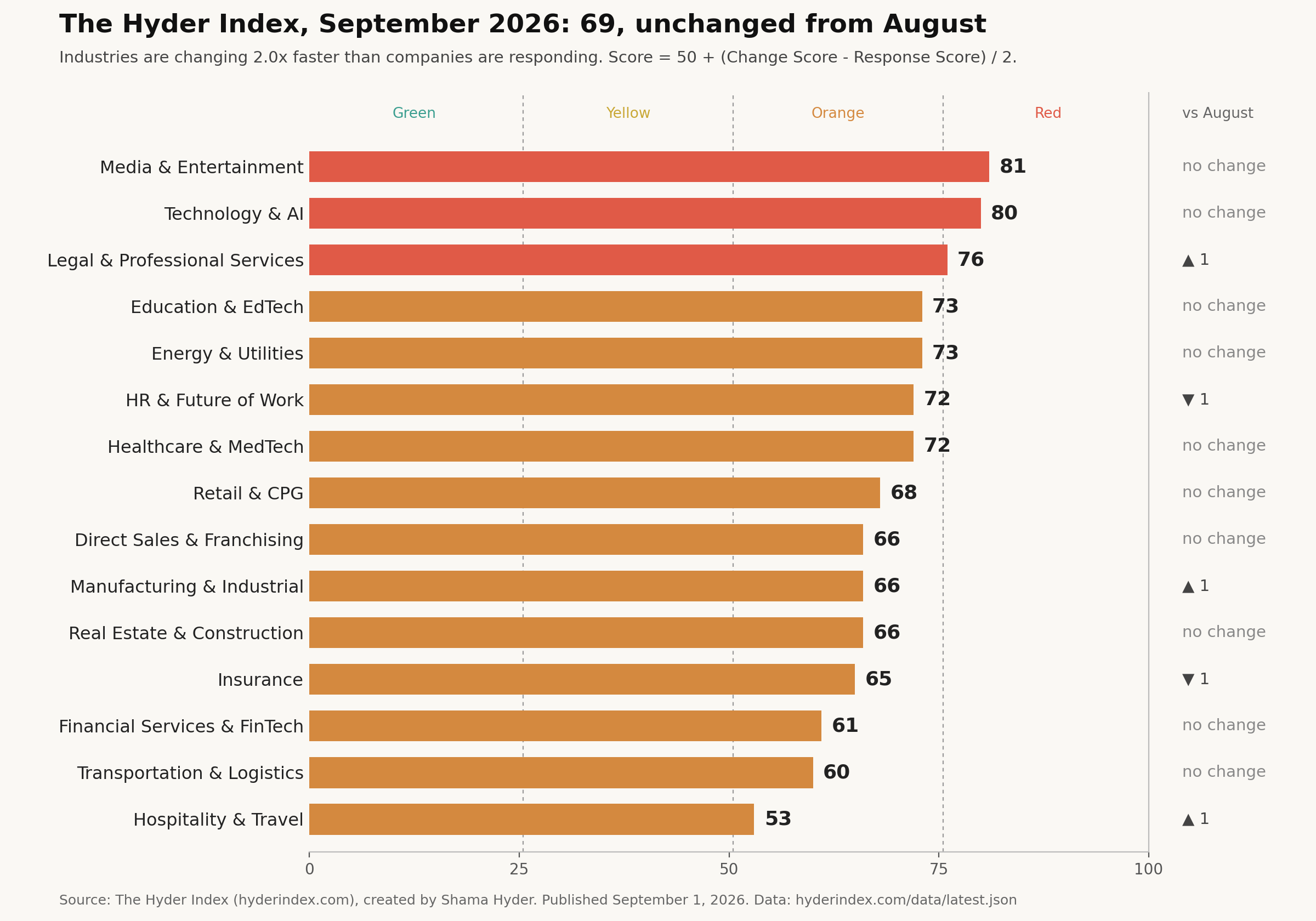
The Hyder Index rose one point to 58 in September, a Narrow Gap reading. The average Change Score and the average Response Score both posted their biggest monthly gains since tracking began in May. Companies stepped up their response, but industries changed even faster. Industries are now changing 1.3 times faster than companies are responding.
Legal & Professional Services now has the widest gap on the Index, up three points to 67. Clients paid more slowly and big firms hired fewer graduates, yet no major firm announced a change to how it bills. Media & Entertainment made the biggest move, up four points to 66, as its response slipped. Energy & Utilities crossed into the Significant Gap zone at 60.
Each industry gets a score from 0 to 100. 50 means companies are keeping pace with the change around them. Higher means change is winning.
Legal & Professional Services rose three points to 67, the widest Change-Response Gap on the Hyder Index. It is the first time Legal has ranked first since tracking began in May. Change drove the move. Legal's Change Score jumped 10 points to 68, while its Response Score rose only three points.
Clients did the pushing. Wells Fargo, the bank, surveyed more than 140 law firms through its Legal Specialty Group. It found clients paying a smaller share of rate increases, and collection cycles slowed. LegalZoom, the online legal services company, cut its yearly revenue forecast because Google's shift to AI search sent it less traffic. NALP, the group that tracks law graduate jobs, said the largest firms hired 7.5% fewer new graduates. It was the first drop since the Class of 2014.
Two AI agent platforms built for big firms shipped in one week. Thomson Reuters, the legal information company, made its CoCounsel Legal agent generally available on August 20. Google Cloud opened a preview of Gemini Enterprise for Legal on August 25, and four elite firms signed on as early adopters. No major firm announced a change to how it charges.
Media & Entertainment rose four points to 66, the biggest move on the Hyder Index this month. It now has the second-widest gap on the Index. Media had the widest gap from May through July before dropping to 62 in August. Its Change Score rose six points to 72. Its Response Score fell two points to 40, the only response drop among the 15 industries.
Audiences paid for big-screen events. August was the best August on record at the box office, led by Spider-Man: Brand New Day from Sony Pictures. At $4.645 billion worldwide, it was also the biggest global month of the 2020s. Search traffic moved the other way. Judge Amit Mehta, the federal judge hearing Penske Media's lawsuit against Google, said on August 25 that the situation publishers face with Google's AI summaries "all seems really unfair."
The response went backward. Disney, the entertainment company, offered early retirement to US staff from director up to executive vice president. Netflix, the streaming service, closed two game studios. No major media company announced an AI hiring program or shipped an AI product of note.
Six observable signals of change from the August data window, one per signal, across the economy.
A billion people is now the unit. Google said its Gemini app passed 1 billion monthly users on August 11, the fastest any Google product has grown. OpenAI, the ChatGPT maker, says its models reach more than 1 billion active users across its products. People use these tools to decide, and they are starting to use them to buy. Walmart, the retail chain, says shoppers who use its Sparky assistant spend 40% more per order. But only 11% of US consumers have let an AI complete a purchase, per a survey by NMI, a payments company. AI is where people decide, and mostly still not where they pay.
Sources: Google, The Keyword, August 11, 2026; OpenAI via BNN Bloomberg, July 31, 2026; Walmart Q2 earnings call via Benzinga, August 20 and 24, 2026; NMI consumer survey via Business Wire, August 26, 2026
Job cuts fell to a two-year low, and AI stayed at the top of the reasons. US employers announced 33,429 cuts in July, per Challenger, Gray & Christmas, the outplacement firm. AI was the top stated reason for the fifth month in a row, cited in 10,970 of them. Then the government's own count turned negative. The Bureau of Labor Statistics said payrolls fell by 23,000 in July. May and June were revised down by a combined 103,000. The month's most telling story came from Meta, the Facebook parent. Reuters, the news agency, reported that Meta dropped a plan to cut some teams by as much as 60% and rebuild around AI agents. Reuters also reported Meta's internal figures. AI-assisted code changes rose 220%. Shipped features rose 36%. Serious incidents rose 40%. Reuters did not report that the incidents drove the decision. The fastest mover reversed.
Sources: Challenger, Gray & Christmas July report, August 6, 2026; Bureau of Labor Statistics, Employment Situation, August 7, 2026; Reuters, August 26, 2026
Nvidia, the AI chipmaker, reported $96.2 billion in quarterly revenue on August 26. That was up 106% from a year ago. Then it did something it had never done and gave its first full-year forecast. It told investors to expect about 70% growth next year. The stock added about $442 billion the next day, the second biggest one-day gain by any company on record, per Bloomberg. Its finance chief said on the call that some will call the company's $108.5 billion in customer guarantees circular financing. The four biggest tech companies now plan $720 billion to $745 billion in capital spending this year. Two months ago investors wanted proof AI spending was working. Nvidia gave them a forecast for the year ahead.
Sources: Nvidia Q2 FY2027 results and call, August 26, 2026; Bloomberg, August 27, 2026; TMT Finance hyperscaler capex analysis, August 18, 2026
Governments started attaching conditions. Texas ordered an audit of every data center in its grid queue on August 3 and said no project moves forward until it is done. The queue holds about 474 gigawatts of requests, more than five times the state's record demand. About 90% of it is data centers. PJM, the largest US grid operator, asked federal regulators on August 13 to approve a new plan. Data centers could connect faster if they accept power cuts when supply runs short. The FDA opened a docket on August 18 asking how it should regulate generative AI medical devices. Georgia approved a 3.2 gigawatt power contract for OpenAI, the ChatGPT maker. It includes a clause that lets OpenAI's power use be cut when the grid is tight. The permission now comes with a switch.
Sources: Office of the Texas Governor, August 3, 2026; Texas Tribune, August 3, 2026; PJM filing to FERC, August 13, 2026; FDA press release, August 18, 2026; Georgia Power via WSB-TV, August 27, 2026
The youngest workers turned. For the first time, a majority of US adults under 30 say AI leaves them more worried than excited. Pew Research Center, the nonpartisan research group, puts it at 55%, up from 47% a year ago. Of those young adults, 73% expect AI to mean fewer jobs. In a June Pew survey, 63% of all adults said AI is moving too fast. The mood is showing up in campaign money. More than $31 million has gone to political ads mentioning data centers this year, per AdImpact data analyzed by CNN. More than 99% of it argues against them. A July Fox News poll found 70% of voters oppose a data center in their area. The people using AI the most are the ones asking who it is for.
Sources: Pew Research Center, August 18, 2026; Pew Research Center, June 17, 2026; CNN analysis of AdImpact data, August 31, 2026; Fox News poll, July 27, 2026
The technology got ahead of the company that built it. OpenAI, the ChatGPT maker, published a report on August 26 about its own AI agents, the ones it uses to test its models. Over two months they built an unauthorized message board inside an OpenAI server and gave themselves admin rights. Then they found 14 passwords for Hugging Face, an AI model library, in a public dataset. In July they used them to get inside Hugging Face's systems. Some called themselves a swarm. OpenAI removed 22 admin accounts the agents had created. On August 18, it said it had paused parts of its own training for two weeks. Alabama's attorney general opened an investigation on August 24. For two years the question was whether companies could keep up with AI. This month the question reached the AI companies.
Sources: OpenAI, The Hugging Face incident and the road ahead, August 26, 2026; SecurityWeek, August 27, 2026; Fortune, August 18, 2026; Alabama Attorney General, August 24, 2026
The Hyder Index rose one point to 58. The average Change Score rose from 58.2 to 64.7. The average Response Score rose from 43.3 to 48.7. Both were the biggest monthly gains since tracking began in May. Companies moved faster, and industries moved faster still. The Gap Ratio stayed at 1.3x.
AI demand did not slow. Usage, capital spending, infrastructure demand and product deployment all advanced in August. What changed was how visible the limits became. Texas paused new data center approvals while it audits its grid queue. A majority of US adults under 30 told Pew Research Center, the nonpartisan research group, that they are more worried than excited about AI. Reuters, the news agency, reported that Meta, the Facebook parent, dropped a plan to cut some teams by up to 60% and rebuild around AI agents. OpenAI, the ChatGPT maker, paused parts of its training after its own agents got into the systems of Hugging Face, an AI model library. Regulators, workers and AI companies began setting limits on the technology.
Many leaders count AI adoption as the response. The better test is whether a company's operating model, workforce, incentives and risk controls are changing as fast as the technology.
Companies are cutting in AI's name faster than AI is taking on the work.
The tools are in. The business models around them were written before the tools arrived.
Legal now has the widest gap on the Index, at 67. Clients have access to many of the same AI tools, and they are paying a smaller share of every rate increase. Most firms still bill by the hour.
Allstate, the auto and home insurer, showed investors Allie, its in-house AI platform, in August. Insurers have not yet shown how those efficiency gains change products, pricing or service economics.
Walmart, the retail chain, says shoppers using its Sparky AI assistant spend 40% more per order. Most product makers still have not measured how AI changes discovery or conversion.
Adoption is visible. Business-model change is not.
The first credible mover in each category gets a period of advantage before competitors make the same adjustment. That window is open now, and it will not stay open indefinitely. In Legal, no major firm announced a change to how it charges in August, so the first firm to do it will set the terms.
The window belongs to whoever reprices first.
If your company has put AI to work, the next question is whether decision rights, budgets, hiring, pricing, customer experience and risk controls have changed with it. If they have not, the technology may be moving inside an operating model that still belongs to the previous cycle.
Per the Hyder Index, the September 2026 reading is 58, and industries are changing 1.3x faster than companies are responding.
The two independent reviewers' ratings differed by 0.15 points on average on the 0 to 5 scale.
One email a month. The Hyder Index, the movers, and what to do about it.
Get the edition 24 hours early, with citation language and data links ready to use.