Widest gap
Media & Entertainment
67
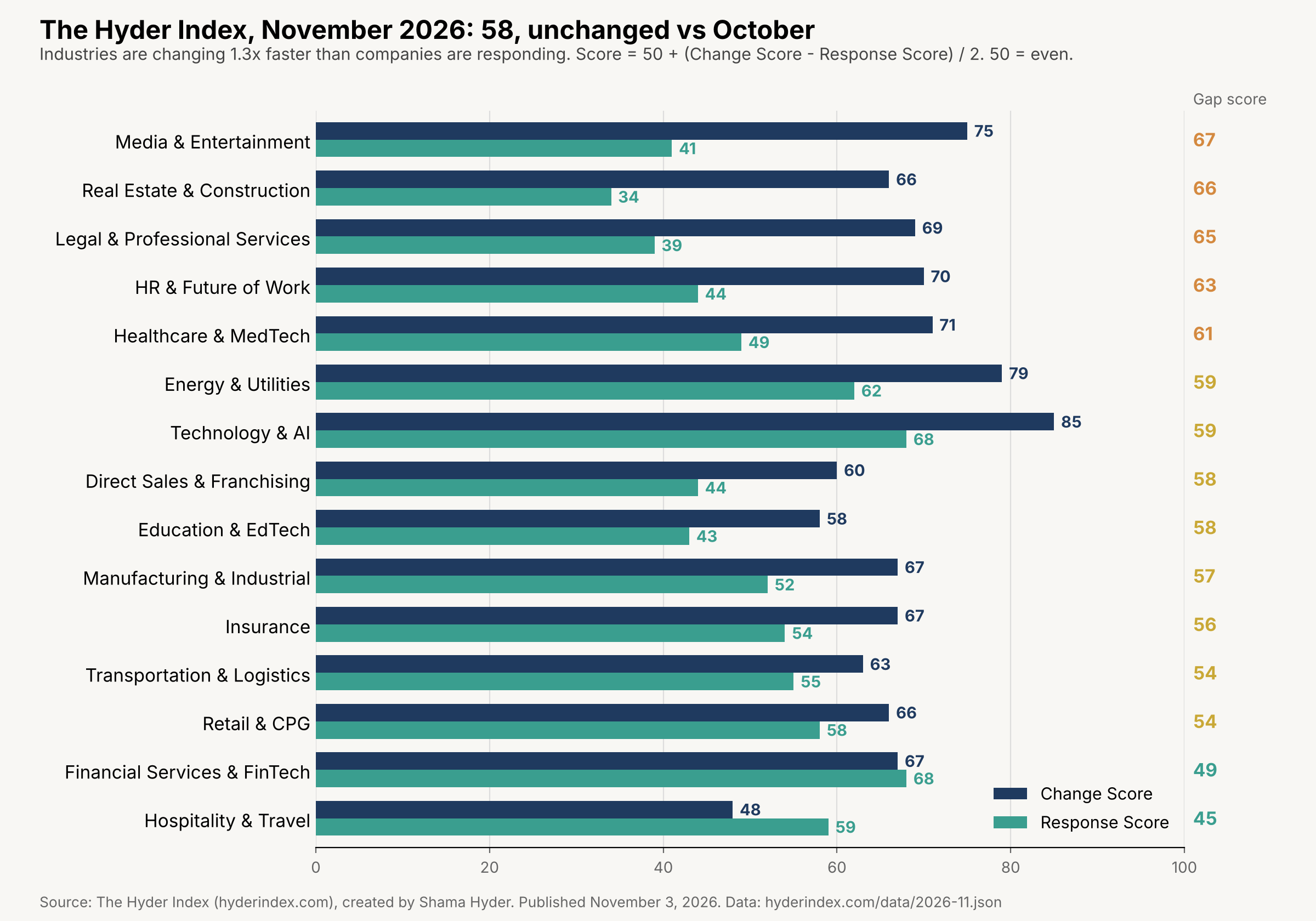
Media & Entertainment has the widest Change-Response Gap on the Index this month.
Measures the Change-Response Gap: how fast industries are changing versus how fast companies are responding. 50 means they are even. Higher means the gap is wider.
Industries are changing 1.3x faster than companies are responding.
Companies are keeping up with about 75% of the change around them.
The Hyder Index measures the Change-Response Gap: how fast industries are changing versus how fast companies are responding. 50 means they are even. Higher means the gap is wider. How we measure it →
Data window: October 1-31, 2026. Published November 3, 2026.
Updated the first Tuesday of every month. Next edition: December 1.
Media & Entertainment has the widest Change-Response Gap on the Index this month.
Education & EdTech fell 3 points to 58.
Financial Services & FinTech, Hospitality & Travel
Education & EdTech fell three points to 58, the largest move on the Index this month. It left the Significant Gap zone for Narrow Gap. Its Response Score rose six points, from 37 to 43, the largest response gain of the 15 industries. Pearson announced acquisitions of ITS and Workera to build an AI-native assessment business. EdSource reported Cal State is the first US public university system to pay for student ChatGPT Edu access. The response is still early. A University of Maryland trial found its AI tutor slightly lowered final grades.
Each industry gets a score from 0 to 100. 50 means companies are keeping pace with the change around them. Higher means change is winning.
Education & EdTech fell three points to 58 in November, the largest move on the Index. It dropped out of the Significant Gap zone and into Narrow Gap. Its Change Score held at 58. Its Response Score rose six points, from 37 to 43, the largest response gain of the 15 industries.
Pearson and several universities acted. Pearson's SEC filing reported its Assessment & Qualifications unit up 10% on demand for verification of AI skills. Pearson also announced two acquisitions, ITS and Workera, to build an AI-native assessment and verification business. Cal State, a 470,000-student system, is the first US public university system to pay for student ChatGPT Edu access, per EdSource. Arden University gave more than 30,000 students and staff access to Gemini Enterprise through Google Cloud. Ohio State and Google announced a partnership, with financial terms undisclosed.
The results are mixed. A University of Maryland randomized trial found its course-connected AI tutor slightly lowered final grades, and only about 15 percent of eligible students used it. The university is holding off on wider rollout. Inside Higher Ed reported that Educause's 2027 Top 10 ranked determining where AI adds real value first, the first time an AI item has held the top spot. Buying access is a step, and the proof comes later.
Media & Entertainment rose one point to 67 and now holds the widest gap on the Index by itself. Last month it shared that spot with Real Estate & Construction at 66. Its Change Score rose three points to 75, and its Response Score rose one point to 41.
Jobs and deals drove the change. TechCrunch reported Netflix is cutting about 1,000 jobs, its biggest layoff in four years. NBCUniversal told staff it is cutting several hundred jobs in its Global Streaming Technology group. Insider Gaming's tracker lists more than 12,000 known game-industry job losses this year. Paramount completed its roughly $111 billion takeover of Warner Bros. Discovery, per AFP, and renamed the combined company Skydance.
The response rose only one point. Prime Video signed a six-year deal to be the exclusive global home of the Emmys from 2027. CNN signed a multiyear deal giving Google expanded rights to its journalism for AI features, and CNN is being paid, though terms were not disclosed. Netflix named Peter Rice chief content officer, effective October 26. Netflix also cut its full-year ad revenue forecast from about $3 billion to $2.7 billion.
Six observable signals of change from the October data window, one per signal, across the economy.
Prices are weighing on households. The University of Michigan's final October sentiment reading was 48.0, roughly flat on September and about 10% below a year earlier. The preliminary reading fell to 46.3 from 47.8, a five-month low. September consumer prices rose 3.7% from a year earlier against 3.6% expected, driven by a 9.1% jump in gasoline. The National Retail Federation forecasts 2026 holiday sales of $1.013 trillion, up 4.2% from 2025. Nearly half of that gain comes from price increases. Shoppers are still spending, but price is doing part of the lifting.
Sources: Axios, October 23, 2026; InvestingLive, October 9, 2026; InvestingLive, October 14, 2026; NRF, October 15, 2026
Hiring is slow, and some cuts now point to AI. Challenger reported US employers announced 43,281 job cuts in September, down 18% from August. It also put hiring plans at the lowest for September since 2011. Payrolls rose just 29,000 in September against about 90,000 expected. Even so, initial jobless claims were 199,000 for the week ended October 10, the fifth straight week below 200,000. AmEx will cut about 5% of its global workforce to prepare for AI adoption. Goldman Sachs estimates AI could displace about 9% of US workers.
Sources: Morningstar / Dow Jones, October 1, 2026; First Trust Portfolios, October 2, 2026; TrendForce DataTrack, October 15, 2026; CNBC, October 23, 2026; Fortune, October 22, 2026
Money is getting more expensive while AI spending keeps climbing. The Fed raised rates 0.25 point to a range of 3.75% to 4.00% in September, and most participants saw another hike as likely appropriate by year end. After the hotter September CPI, markets raised the odds of a hike at the October 27 and 28 meeting from 21% to 47%. Meta set its 2026 capital spending guidance at $135 billion to $145 billion. Its third-quarter spending of $34.91 billion exceeded operating cash flow. Bloomberg reported Ramp raised about $1.85 billion at a $60 billion pre-money valuation, up from $44 billion in June.
Sources: Scotsman Guide, October 7, 2026; InvestingLive, October 14, 2026; Bloomberg, October 22, 2026; FinTech Futures, October 15, 2026
Enforcement and rules landed on several fronts. The FTC sent civil investigative demands to OpenAI and Anthropic on October 14, seeking records on security incidents, safeguarding practices and marketing. The Labor Department suspended Microsoft, Adobe, Cognizant, Infosys, TCS, Wipro, HCL and Capgemini from the PERM green card program, halting new and pending filings. The OCC issued the first final federal GENIUS Act rule, effective January 18, 2027. The Energy Department filed its first FERC statement of position in at least five years. It urged PJM to revise its plan so data centers, not existing customers, bear large-load costs.
Sources: Axios, October 15, 2026; The Next Web, October 8, 2026; OCC, October 21, 2026; Utility Dive, October 7, 2026
Trust in AI is being tested in courts and classrooms. Attorneys general in eight states sued OpenAI on October 14, alleging it misled users about ChatGPT safety and harms to young users. A University of Maryland randomized trial found its course-connected AI tutor slightly lowered final grades, and about 15 percent of eligible students used it. Inside Higher Ed reported that Educause's 2027 Top 10 ranked determining where AI adds real value first, the first time an AI item has held the top spot. CNBC reported that AI is changing how lawyers work and putting pressure on the billable hour model.
Sources: Al Jazeera, October 15, 2026; Inside Higher Ed, October 7, 2026; Inside Higher Ed, October 5, 2026; CNBC, October 10, 2026
Costs and supply chains are under strain. The New York Fed's October Empire State manufacturing index jumped to 25.5 from 7.6 in September, while supply availability worsened to its weakest since June 2022. The S&P Global flash composite PMI was 57.6 in October, with selling prices rising at the fastest pace since August 2022. ISM's September Prices index jumped 6.8 points to 77.9%. United Airlines said its third-quarter fuel expense climbed 61.6% to $4.84 billion. On the technology side, OpenAI began rolling out GPT-6 in ChatGPT on October 7.
Sources: Trading Economics, October 15, 2026; Newsquawk, October 23, 2026; ISM, October 1, 2026; U.S. News (Reuters), October 20, 2026; Let's Data Science, October 7, 2026
The Hyder Index held at 58 in November, the third month in a row at that number. The average Change Score is 67.4, up from 65.6 last month. The average Response Score is 51.3, up from 49.6.
So industries are still changing 1.3 times faster than companies respond. The Change-Response Gap has read 1.3 since August. Two industries are in Keeping Pace, five are in Significant Gap, and none is in Critical Gap. Education and Energy both moved from Significant Gap to Narrow Gap.
Education's score fell three points, so it can look like schools have caught up. Its response did rise six points, from 37 to 43. That is still below the Index average of 51.3.
Look at what sits inside the rise. Cal State is paying for student ChatGPT Edu access, and Pearson announced two acquisitions. Yet a University of Maryland trial found its AI tutor slightly lowered final grades, and only about 15 percent of eligible students used it. Access is a first step. Use and results come after it.
Third-quarter earnings season is where companies put numbers behind AI plans. Bank of America named about 130 AI projects in production, with estimated benefits of $250 million to $300 million this year. Schneider Electric, GE Aerospace and Honeywell raised their outlooks.
The Fed met October 27 and 28, after a September rate increase. After the September CPI report on October 14, markets put the odds of a hike at that meeting at 47%, up from 21%. Money is costing more, and Meta still set 2026 capital spending guidance of $135 billion to $145 billion.
Next, the NAIC meets in November, with a nationwide claims-AI examination as its rollout target. Holiday sales will test the National Retail Federation's forecast. Southwest raised its fourth-quarter fuel assumption and has no active fuel hedges.
Find the one cost that rose most for you this quarter, whether it is fuel, rates or labor. Pick one workflow where AI could bring it down. Set a date and a number, and say both out loud to your team and your customers. Then report the result on your next earnings call, board update or client letter.
Per the Hyder Index, the November 2026 reading is 58, and industries are changing 1.3x faster than companies are responding.
The two independent reviewers' ratings differed by 0.06 points on average on the 0 to 5 scale.
One email a month. The Hyder Index, the movers, and what to do about it.
Get the edition 24 hours early, with citation language and data links ready to use.